Reported Speech: тренировка косвенной речи
В упражнениях нужно закончить предложения в косвенной речи, например John offered to sing for me или He suggested taking aspirin. К заданиям даны переводы предложений, которые помогают проверить свои ответы и понять модель.
Содержание статьи
- Упражнение на специальные вопросы
- Ключи к упражнению на вопросы
- Косвенная речь в английском языке. Упражнения Reported Speech Advanced
- Упражнения на Reported Speech (advanced)
- Цитаты известных людей в косвенной речи
- Шутки в косвенной речи
- Преобразования при переходе в косвенную речь
- Слова времени и места в косвенной речи
- Модальные глаголы
- Условные предложения
- Вопрос в прямой речи
- Повелительное наклонение
1. Закончите предложения в косвенной речи.
Например: Let me sing for you. (Разрешите мне спеть для вас.) - John offered to sing for me. (Джон предложил спеть для меня.)
1. "Why don't you take some aspirin?" (Почему бы тебе не выпить аспирин?) - He suggested .... (Он предложил ...)
2. "You should never tell lies." (Нельзя говорить неправду.) - Mary taught us ... (Мэри учила нас ...
3. "I will not swim so far." (Я не поплыву так далеко.) - He refused ... (Он отказался ...)
4. "Please don't shout at me." (Пожалуйста, не кричи на меня.) - Kate begged ... (Кэйт умоляла ...)
5. "Put some mushrooms in the soup." (Добавь немного грибов в суп.) - Father told ... (Папа сказал ...)
6. "Could you wash up after our dinner?" (Ты не мог бы помыть посуду после нашего ужина?) - She asked ... (Она попросила ...)
2. Преобразуйте общие вопросы в косвенную речь, обращая особое внимание на времена.
Например: Can I have some pocket money? (Можно мне немного карманных денег?) - His son asked if he could have some pocket money. (Его сын спросил, можно ли ему немного карманных денег.)
1. Do you live in Brazil? (Ты живешь в Бразилии?) - They asked her ...
2. Is Johnny dancing rock-n-roll? (Джонни танцует рок-н-ролл?) - She wondered ...
3. Are they angry with him? (Они на него злятся?) - We wanted to know ..
4. Has Lara finished her lunch? (Лара закончила обедать?) - I asked ...
5. Will she show me her paintings? (Она покажет мне свои картины?) - He wondered ...
6. Did you work as a sales assistant? (Ты работал продавцом?) - I asked him ...
7. Can I go to the playground? (Можно мне пойти на игровую площадку?) - My niece asked me ...
8. Does Mike produce dairy products? (Майк производит молочные продукты?) - They wondered ...
Упражнение на специальные вопросы
3. Преобразуйте специальные вопросы в косвенную речь.
Например: Where did you buy such a lovely dress? (Где ты купила такое красивое платье?) - I asked my mother where she had bought such a lovely dress. (Я спросила маму, где она купила такое красивое платье.)
1. How far is the hospital? (Как далеко находится больница?) - She wanted to know ..
2. Where are they? (Где они находятся?) - I asked ...
3. Why were the kids frightened? (Почему дети были напуганы?) - He wondered ...
4. When can I call you back? (Когда я могу тебе перезвонить?) - I asked her ...
5. Which boat did Tom choose? (Какую лодку выбрал Том?) - We wondered ...
6. How often do you load the paper into the tray? (Как часто ты загружаешь бумагу в лоток?) - She asked him ...
7. When will the ceremony start? (Когда начнется церемония?) - I wanted to know ...
8. How many fish has he caught? (Сколько рыбы он поймал?) - We wondered ...
9. Why did you play a trick on her? (Зачем ты над ней подшутил?) - I asked him ...
10. What does she sell in the market? (Что она продает на рынке?) - They asked ...
1.
1. He suggested I should take some aspirin.
2. Mary taught us not to tell lies.
3. He refused to swim so far.
4. Kate begged not to shout at her.
5. Father told to put some mushrooms in the soup.
6. She asked to wash up after their dinner.
2.
1. They asked her if she lived in Brazil.
2. She wondered if Johnny was dancing rock-n-roll.
3. We wanted to know if they were angry with him.
4. I asked if Lara had finished her lunch.
5. He wondered if she would show him her paintings.
6. I asked him if he had worked as a sales assistant.
7. My niece asked me if she could go to the playground.
8. They wondered if Mike produced dairy products.
Ключи к упражнению на вопросы
3.
1. She wanted to know how far the hospital was.
2. I asked where they were.
3. He wondered why the kids had been frightened.
4. I asked her when I could call her back.
5. We wondered which boat Tom had chosen.
6. She asked him how often he loaded the paper into the tray.
7. I wanted to know when the ceremony would start.
8. We wondered how many fish he had caught.
9. I asked him why he had played a trick on her.
10. They asked what she sold in the market.
Тест по английскому языку по теме: "Прямая и косвенная речь" для учащихся 8 класса к учебнику В.П.Кузовлев.
II вариант
The following sentences are direct speech. Complete each sentence below using reported speech.
- She said, "How many hours a day do you watch TV?"
- She said, "Don`t write a letter to Ann."
- He asked, "What magazines do you prefer to read?"
- She said, "Tom is leaving tomorrow night."
- "Have you had your hair cut?", my mother asked me.
- The chief ordered, "Go to the theatre and book the tickets."
- She said, "Kent has visited many countries in western Europe."
- I said, "Don`t drink coffee at night, you will not sleep."
- He read, "The south of England is warmer than the North."
- "Are you going to pick up the phone?", Miranda asked him.
- He said, "Bring me some water, please."
- She was surprised, "Somebody stole my bag in the shop"
- She asked, "Does this film about police and crime?"
- "Please don`t tell anybody what happened", Ann said to me.
- He said, "I can` t move the piano alone."
- She said, "Dairy products are useful for little children."
- The teacher said, "What do you do to express yourself?"
- She said, "Doctors don`t advise us to eat chips and chocolate."
- I asked my Dad, "Did you take part in the Great Patriotic War?"
- The girl said, "All the guys try to look really cool driving up and down in their dad`s car."
- She said," Limit saturated fats."
- She said, "Do you often take your blood pressure?"
- She said, "Eat lots of fruits veggies and grain."
- He said, "Call a doctor if you have a strong pain in the heart."
- He said, "I am going to buy a new car."
Косвенная речь в английском языке. Упражнения Reported Speech Advanced
Перевод предложений в косвенную речь (повторение)
Упражнение 1. Переведите повествовательные предложения в косвенную речь.
- I The secretary has said, "The press conference is taking place now in the main hall".
- My brother has said, "Aunt Sally will come on Monday."
- The students have said, "We had two tests last week."
- Her daughter said, "I am not listening to music now."
- My friend said, "I have visited all these places,"
- Tom said, "'I am a first year student now."
- She said, "I have not been speaking to him since yesterday."
- Susan said, "I was in the library two days ago."
- The boy said, "I was not watching TV in my home at 8 o'clock."
- The teacher said, "They have been writing since early morning".
- He said, "I will visit you next Friday."
- She said, "I will be leaving my home at 10 o'clock tonight"
Упражнение 2 . Переведите общие вопросы в косвенную речь.
- John asked, "Has anybody seen the film?"
- He asked, "Are you listening to music now?"
- She asked, "Have you been working hard on this problem?"
- She asked, "Were you in the library yesterday?"
- He asks, "Does she work now?"
- He asks, "Has she been reading this book since Monday?"
- Jane asked, "Can anybody tell me what you have been discussing all the time?"
- He asked, "Will you be at Nick and Carol's party tonight?"
Упражнение 3 . Переведите специальные вопросы в косвенную речь.
- Where is he going? (He didn't tell anybody..)
- Where has he gone? (Did you know...)
- Where is he? (Did you know...)
- When is he leaving school? (I wanted to know...)
- Where does he live? (Nobody knew...)
- When will he come back? (She asked them...)
- Where did she buy this hat? (He wanted to know...)
- How much did she pay for it? (I had no idea...)
Упражнение 4. Переведите повелительные предложения в косвенную речь.
- The army captain said, "Don't shoot!"
- The police officer said, "Put your hands over your head!"
- The flight attendant said, "Fasten your seat belts!"
- The teacher said, "Don't use your dictionaries!"
- The doctor said, "Take this medicine three times a day."
- The firefighter said, "Don't go near the house, it is dangerous!"
Упражнение 5. Найдите ошибки в предложении.
- The instructor asked me if I can swim and I said I can.
- He said me that he had been waiting for me here.
- She asked me where I had lived two years ago.
- Mr. Grey told that he missed his hometown.
- The parking attendant directed to park our car on the left.
- The man asked the boy to tell him what is the time.
- He wanted to know why Bob is missing a class today.
- He asked me if Ted had been sick yesterday.
Упражнение 6. Прочитайте диалог.
A.: Excuse me? В.: Yes...
A.: This chicken is underdone.
В.: What do you mean?
A.: It's not cooked.
В.: Yes, it is.
A.: No, it isn't.
В.: Look, that's how we always serve it.
A.: Well, I don't want it. And I won't pay.
В.: You'll pay whether you eat it or not.
A.: In that case, I want to see the manager.
В.: I'm the manager.
Используя косвенную речь, расскажите о ситуации. Например, начните так:
"I ordered the chicken. It wasn't properly cooked. I told the waiter..."
Упражнение 7. Прочитайте текст и перепишите его, используя прямую речь.
The waiter recommended the fish. When it arrived, it was inedible. I summoned the waiter and complained that the fish was uncooked. He appologized and offered to replace it. I told him that I wasn't hungry, and requested the bill... .
Упражнения на Reported Speech (advanced)
Упражнение 8. Переведите предложения ниже в косвенную речь, используя глаголы:ask, beg, congratulate, thank, insist, offer, object, refuse, invite, suggest, complain, remark .
1."Please, please, do as I say", I said.
2. Peter, "I will pay."
Alec, "Oh, no you mustn't".
Peter, "I insist on paying"
3."Hurray, I've passed my exam!"
"Congratulations", - I said.
4."Many happy returns of the day", we said.
"Thank you," said the boy.
5."Let us wait here till the rain stops," I said.
6."Oh, I've hit my thumb with the hammer!" Peter cried.
7."Have an apple," Mary said. - "No, thanks," I replied.
8."What about going for a walk?" he said. - "It's quite fine now."
Упражнение 9. Переделайте предложения с прямой речью в предложения с косвенной речью, используя глаголы: advise, remind, warn, invite, ask, encourage.
- R u t h: Don't forget to post the letter, Bruno.
- R i с h a r d: Carolina, I think you should see a doctor.
- К a t h y: Olivia, please do the dishes.
- R u t h: Patrice, would you and Manny like to come to dinner?
- M a r i a: Roger, close the door, please.
- M о t h e r: Ben, don't touch the heater.
- M i k e: Vicki, why don't you run in the marathon?
- Be careful! Don't sit down, that paint is wet.
Упражнение 10. Прочитайте совет врача и переведите его на английский язык .
Медсестра спросила меня, ожидаю ли я доктора Грея, и пригласила меня к нему в кабинет (surgery).
Доктор Грей улыбнулся мне и спросил, что меня беспокоит. Я сказал, что ужасно переутомлен (be run down). Он спросил меня, поздно ли я ложусь спать (stay up late), и я сказал, что нет. Он поинтересовался, почему я не соблюдаю нормальный режим (keep regular hours), и я объяснил, что почти каждый вечер я встречаюсь с друзьями.
Доктор захотел узнать, как я провожу время, и я сказал, что в основном (mostly) я хожу на вечеринки. Доктор спросил меня, удается ли (have the chance) мне отдохнуть (to recover) в выходные дни, но я вынужден был признать (admit), что в выходные дни наши вечеринки длятся всю ночь.
Он спросил меня, курю ли я, и когда я сказал, что курю, доктор спросил меня, сколько сигарет в день я выкуриваю. Он был поражен, когда услышал мой ответ.
Тогда врач спросил меня, занимаюсь (take) ли я гимнастикой для поддержания своего здоровья (to keep fit). Я ответил, что для этого у меня нет времени.
Цитаты известных людей в косвенной речи
Упражнение 11. Передайте в косвенной речи цитаты известных людей. Запомните три из них .
1. "I can't resist anything but temptation. " (Oscar Wilde)
Oscar Wilde said that...
2. "It has long been an axiom of mine that the little things are the most important"(Conan Doyle)
Conan Doyle said that ...
3. "The world is so full of a number of things, I'm sure we should all be happy as kings". (Robert Stevenson)
Robert Stevenson wrote that...
4. "Always do what you are afraid to do" (Ralf Emerson, American poet and essayist)
Ralf Emerson wanted us....
5. "Never take anything for granted". (Benjamin Disraeli)
Benjamin Disraeli asked us....
6."If a man doesn't make new friends as he advanced through life - he will soon find himself alone. A man should keep his friendship in constant repair." (Samuel Johnson, English writer)
Samuel Johnson warned us that...
7. "If you want to be successful, you must look successful. "(Thomas Moore, Irish poet)
Thomas Moore said if...
8. "Don't anticipate trouble or worry about what may never happen. Keep in the sunlight."(Benjamin Franklin)
Benjamin Franklin advised us...
9. "Every man has three characters: that which he exhibits, that which he has and that which he thinks he has. " (Karr)
Karr thought that...
Упражнение 12. Перепишите шутку в прямой речи.
- be annoyed - быть раздраженным
- patient - терпеливый
- calm - спокойный
- sensible - разумный
- swear - ругаться
- wave - махать
- small things - пустяки
One day, when Jack the Patient came home from work he found his wife very annoyed about something.
- He asked what the matter was.
- And she answered that she had been annoyed by a bee.
- Jack the Patient continued that he had always been more sensible than his wife so he was going to give her a lecture at the moment.
- He added that he would prove to her the importance of always remaining calm.
- He said it was a waste of time and strength to get excited about small things.
- He told her to train herself to be patient like him.
- He asked her to look at the fly that had just landed on his nose.
- He asked if he was getting excited or annoyed, if he was swearing or waving his arms around.
- He explained that he wasn't, he was perfectly calm. Just as he had said that Jack the Patient started shouting. He jumped up and began to wave his arms around wildly and swear terribly.
- His wife got surprised and asked what had made him so excited. He couldn't say a word for some time. But at last he was able to tell his wife that the thing on his nose hadn't been a fly, it had been a bee!
Шутки в косвенной речи
Упражнение 13. Перепишите шутки в косвенной речи, не забывая про подчеркнутые слова.
- Mummy, why is it cold today ?
- It is winter now. It's always cold in winter.
- But why is it always cold in winter?
- Oh, Susan, I didn't ask my mother so many questions.
- Now I understand why you can't answer my questions!
Susan asked her mother .... Her mother answered .... Susan repeated the question .... Susan's mother got angry and exclaimed that.... Susan came to the conclusion that....
- Daddy, can you write in the dark?
- Of course, I can.
- Then turn off the light and sign my report card (дневник), please.
Susan wondered .... Her father answered .... Then she asked him to ....
The client: It's the most terrible fish I've ever eaten. Bring me the fish I ate in this restaurant last week .
The waiter: Sorry, sir, but it's the same fish.
Вill: I broke off my engagement to Mary two months ago .
Tom: But why? Have you told her about your rich uncle?
Bill: Yes, I have. She's my aunt now .
Teасher: Why are you late this morning , Jack?"
Jack: I pressed the toothpaste so hard that it took me half an hour to get the paste back into the tube.
Вill: I saw the doctor last Monday about my loss of memory.
Tom: What did he do?
Bill: He made me pay in advance.
Kate: What did you hear at the opera yesterday ?
Jane: All sorts of things: Oleg is going to London next month, Boris passed his exam last week, Ann took the first place in the literature Olympiad two days ago .
The tourist: Are you sure there are no crocodiles here ?
The guide: Yes, I am. We haven't found any crocodiles here .
The tourist: I think I can have a swim in this river tomorrow . And what makes you think there are no crocodiles in this place?
The guide: They are afraid of the sharks.
Mrs Worry: Does your son smoke?
Mrs Calm: No, he doesn't.
Mrs Worry: Does he go out late?
Mrs Calm: No, he doesn't. He went to bed after dinner yesterday .
Mrs Worry: What is he doing now ?
Mrs Calm: He is watching cartoons.
MrsWorry: Oh, he is an ideal son. How old is he?
Mrs Calm: Three years today .
Mr Green: Last month a grain of sand got into my wife's eye and she had to go to a doctor. I had to pay two hundred dollars for it.
Mr White: That's nothing, last week a fur coat got into my wife's eye and I had to pay two thousand dollars for it.
Напоследок, устный тренинг по теме "Косвенная речь в английском языке. Reported Speech (advanced)"
Упражненеие 14. Переведите предложения, запомните свой ответ и проверьте себя.
- Он говорит, что Мэри сделает это.
- Он только что сказал мне, что урок начался.
- Он сказал мне, что урок начался.
- Он попросил ее дать ему стакан воды.
- Она сказала ему прийти в 5 часов.
- Не says (that) Mary will do it.
- He has just told me that the lesson has begun.
- He told me that the lesson had begun.
- My brother has just said that he will come at 5 o'clock
- Не said that he got up at 8 o'clock.
- He said that the delegation would leave at the end of the week.
- Не said that he would write the letter that day.
- Не asked me where I lived.
- Не asked me when they would send the documents.
- Не asked me if (whether) I had received his telegram.
- He asked her to give him a glass of water.
- She told him to come at 5 o'clock.
Очень часто в речи нам нужно передать чьи-либо слова (кто-то что-то сказал), и зачастую мы это делаем своими собственными словами, избегая прямой речи. Как мы это делаем? Очень просто, мы превращаем её в придаточное предложение.
John said, "I want to get a new job". - Джон сказал: "Я хочу получить новую работу".
John said (that) he wanted to get a new job. - Джон сказал, что он хочет получить новую работу.
О том, как это сделать корректно мы и будем говорить далее.
В английском языке есть ряд особенностей, которые следует учитывать при изменении прямой речи в косвенную.
Для того чтобы перевести прямую речь в косвенную, нужно опустить запятую после слов, вводящих прямую речь, и кавычки. Часто косвенная речь в английском языке вводится союзом that , который, впрочем, может быть опущен (именно поэтому мы поставили слово that в скобки в примере выше).
Вы должны были обратить внимание, что у нас изменилась временная категория (I want на I wanted ), подобное явление в английском языке называется согласование времён (это зависимость времени глагола в придаточном предложении от времени глагола в главном).
Преобразования при переходе в косвенную речь
В таблице ниже Вы сможете увидеть все случаи подобных трансформаций.
Если сказуемое главного предложения стоит в настоящем или будущем времени, то сказуемое придаточного будет стоять в том самом времени, которое было в прямой речи.
Немного сложнее ситуация, если сказуемое главного предложения стоит в прошедшем времени, здесь как раз и вступает в силу те самые правила согласования времён.
| Прямая речь (Direct Speech) | Косвенная речь (Indirect Speech) |
|---|---|
| Present Simple | Past Simple |
| He said, "I go to bed" - Он говорит: "Я иду спать". | He said (that) he went to bed. - Он сказал, что идёт спать. |
| Present Continuous | Past Continuous |
| Mark said, "I am doing my homework". - Марк говорит: "Я делаю мою домашнюю работу". | Mark said (that) he was doing his homework. - Марк сказал, что делает свою домашнюю работу. |
| Past Simple | Past Perfect |
| She said, "I made a cake". - Она сказала: "Я приготовила торт". | She said (that) she had made a cake. - Она сказала, что приготовила торт. |
| Present Perfect | Past Perfect |
| Alex said, "I have been to London". - Алекс сказал: "Я был в Лондоне". | Alex said (that) he had been to London. - Алекс сказал, что он был в Лондоне. |
| Past Continuous | Past Perfect Continuous |
| They said, "We were playing football". - Они сказали: "Мы играли в футбол". | They said (that) they had been playing football. - Они сказали, что играли в футбол. |
| Present Perfect Continuous | Past Perfect Continuous |
| She said, "I have been watching this film for 2 hours". - Она сказала: "Я смотрела этот фильм на протяжении двух часов". | She said (that) she had been watching that film for 2 hours. - Она сказала, что смотрела тот фильм на протяжении двух часов. |
| Future Simple | Future Simple in the Past |
| He said, "I will buy a car". - Он сказал: "Я куплю машину". | He said (that) he would buy a car. - Он сказал, что купит машину. |
| Past Perfect | НЕ ИЗМЕНЯЕТСЯ |
| James said, "I had built my house". - Джеймс сказал: "Я построил дом". | James said (that) he had built his house. - Джеймс сказал, что построил дом. |
| Past Perfect Continuous | НЕ ИЗМЕНЯЕТСЯ |
| She said, "I had been reading for 3 hours". - Она сказала: "Я читала на протяжении трёх часов". | She said (that) she had been reading for 3 hours. - Она сказала, что читала на протяжении трёх часов. |
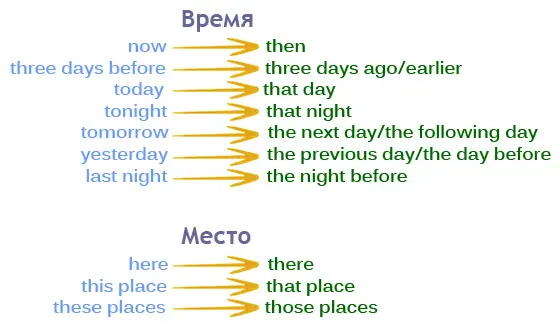
Слова времени и места в косвенной речи
Важно также помнить, что кроме самих глаголов при согласовании времен нам нужно учитывать и изменение наречий и местоимений .
Личные и притяжательные местоимения
Olga said, "I
will give you
back your
book". - Ольга сказала: "Я отдам тебе твою книгу".
Olga said (that) she
would give me
back my
book. - Ольга сказала, что она отдаст мне мою книгу.
Вы не можете сказать:
you back your book. - Ольга сказала мне, что она отдаст тебе твою книгу.
а, как и в русском, Вы скажете:
Olga said that she would give me back my book. - Ольга отдаст мне мою книгу.
Указательные местоимения и наречия времени и места
| Прямая речь | Косвенная речь |
|---|---|
| this (этот) | that (тот, этот) |
| these (эти) | those (те, эти) |
| now (теперь) | then (тогда) |
| here (здесь) | there (там) |
| today (сегодня) | that day (в тот день) |
| tomorrow (завтра) | the next day (на следующий день) |
| the day after tomorrow (послезавтра) | two days later (через два дня) |
| yesterday (вчера) | the day before (накануне) |
| the day before yesterday (позавчера) | two days before (двумя днями раньше) |
| ago (тому назад) | before (раньше) |
| next year (в будущем году) | the next year, the following year (в следующем году) |
| last night (вчера вечером, ночью) | the previous night (предыдущим вечером, ночью) |
То есть при переводе в косвенную речь нашей фразы:
Richard said, "I went to my parents yesterday ". - Ричард сказал: "Вчера я ездил к моим родителям".
Мы получим:
Richard said (that) he had gone to his parents the day before . - Ричард сказал, что вчера ездил к своим родителям.
Ещё пример:
She said, "I saw this
film last night
". - Она сказала: "Я видела этот фильм прошлой ночью".
She said (that) she had seen that
film the previous night
. - Она сказала, что видела тот фильм предыдущей ночью.
Модальные глаголы
Вам также пригодится информация о том, как ведут себя модальные глаголы при переходе из прямой в косвенную речь.
Mike said, "I can
cook this dish". - Майк сказал: "Я могу приготовить это блюдо".
Mike said (that) he could
cook that dish. - Майк сказал, что он может приготовить то блюдо.
She said, "I could
go to school". - Она сказала: "Я могла пойти в школу".
She said (that) she could
go to school. - Она сказала, что могла пойти в школу.
Условные предложения
Иногда нам также нужно переделать условные предложения в косвенную речь.
I тип условного предложения меняется по правилам согласования времён.
If the weather is
fine, I will
go outside. - Если погода будет хорошая, я пойду на улицу.
He said if the weather was
fine, he would
go outside. - Он сказал, что если погода будет хорошей, то он пойдёт на улицу.
Условные предложения II и III типа не меняют свою форму.
II тип:
If the weather were
fine, I would
go outside. - Если бы погода была хорошая, я бы пошёл на улицу.
I said if the weather were
fine, I would
go outside. - Я сказал, что если бы погода была хорошая, то я бы пошла на улицу.
III тип:
If the weather had been
fine yesterday, I would have gone
outside. - Если бы погода была хорошая вчера, то я бы вышел на улицу.
I said if the weather had been
fine, I would have gone
outside. - Я сказал, что если бы погода была хорошая вчера, то я бы вышел на улицу.
Вопрос в прямой речи
Теперь такой момент, допустим у Вас есть вопрос в прямой речи , который нужно перенести в косвенную речь.
В отличие от вопроса в прямой речи, где в большинстве случаев существует обратный порядок слов (кроме вопросов к подлежащему) - перед подлежащим стоит сказуемое или его часть,
вопросы в косвенной речи имеют структуру повествовательного предложения, т.е. прямой порядок слов (подлежащее, за ним сказуемое)
Знак вопроса в конце такого предложения отсутствует, вспомогательный глагол to do в Present и Past Indefinite не употребляется.
She asked me, "When did you see me?" - Она меня спросила: "Когда ты меня видела?"
She asked me when I had seen her
. - Она меня спросила, когда я её видела.
He asked me, "Who showed you my notes?" - Он меня спросил: "Кто показал тебе мои записи?"
He asked me who had shown
me his notes. - Он меня спросил о том, кто показал мне его записи.
Тут мы видим вопрос к подлежащему, и здесь вообще нет вспомогательного глагола.
Общие вопросы заменяются придаточным предложением, которое присоединяется к главному при помощи союзов if и whether , имеющих значение частицы ли. Запятая не ставится.
She asked me, "Do you know my husband?" - Она меня спросила: "Ты знаешь моего мужа?"
She asked if (whether)
I knew her husband. - Она меня спросила, знаю ли я её мужа.
Повелительное наклонение
И последний случай, с которым Вы можете столкнуться в этой теме - это преобразование повелительного наклонения . В косвенной речи повелительное наклонение заменяется инфинитивом.
He said to me, "Open the window". - Он мне сказал: "Открой окно".
He asked me to
open the window. - Он попросил открыть окно.
Если прямая речь выражает приказ , тогда мы заменяем глагол to say (сказать) на to tell (велеть, сказать) или to order (приказывать) . Если прямая речь выражает просьбу, тогда глагол to say мы заменяем на to ask (просить)
She said to me
, "Give me a pen". - Она сказала: "Дай мне ручку".
She told me
to give her a pen. - Она мне сказала дать ей ручку.
Что касается отрицательной формы, в косвенной речи в повелительном наклонении отрицание заменяется инфинитивом с частицей not .
James said to her, "Don"t go". - Джеймс ей сказал: "Не уходи".
James asked her not to go
. - Джеймс попросил её не уходить.